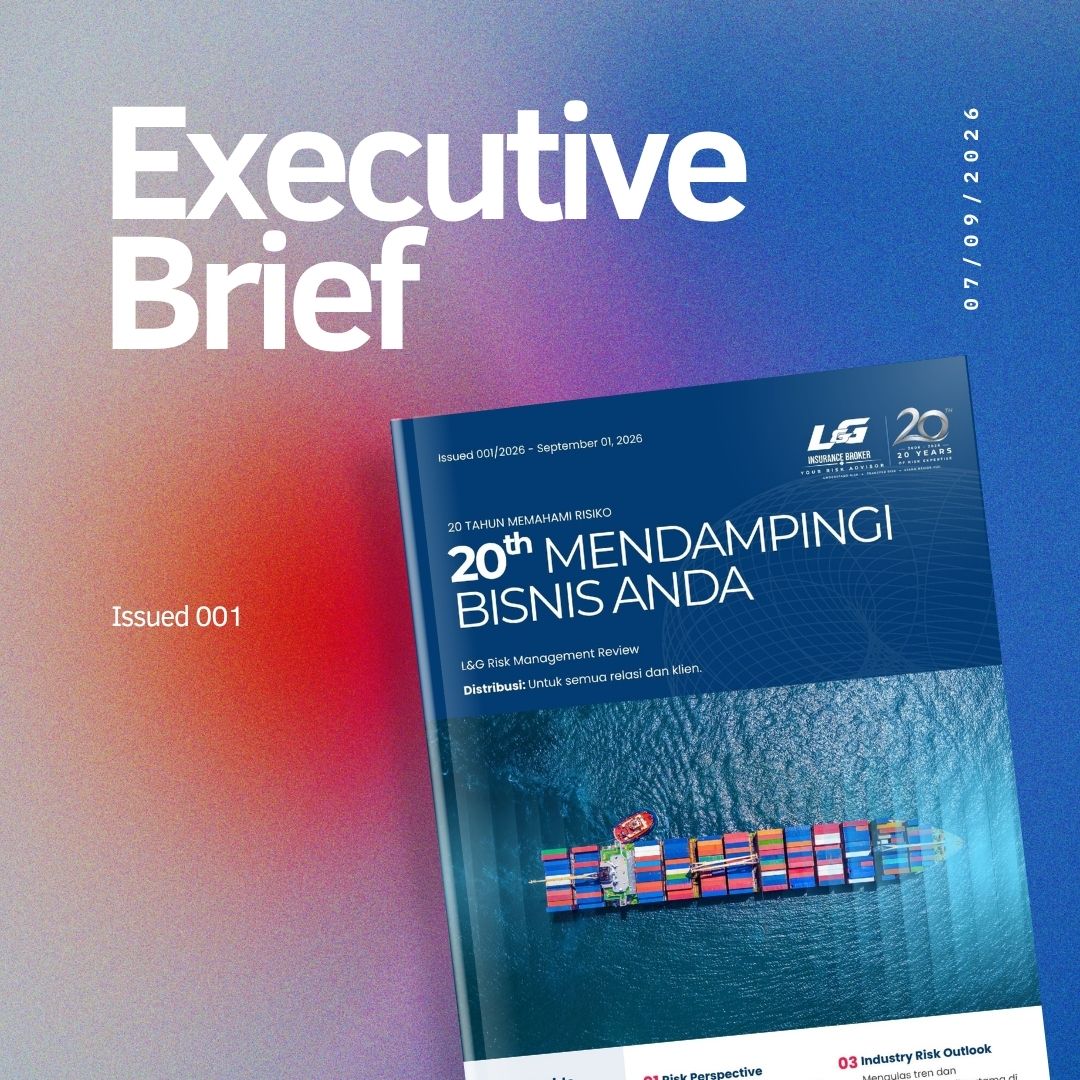
Understanding Risk Before It Happens

Business risks continue to evolve as industries grow, operations become more complex, and new exposures emerge. This Risk Review highlights practical risk perspectives—from climate and cargo risks to project accidents and claims—helping businesses better understand potential exposures and make more informed decisions before risks become losses.

A closer look at the risks shaping business resilience in 2026

Business risks rarely emerge from a single event. They often develop from changing conditions, small oversights, operational decisions, and circumstances that are difficult to predict.

In its first L&G Risk Management Review, L&G looks at several situations that illustrate how risk can affect businesses — from changing climate conditions and cargo transportation to project accidents, claims management, and emerging risks across Indonesia’s key industries.

The common lesson is simple:

Understanding risk before it happens creates better decisions when it matters most.

A Business Environment Where Risk Keeps Changing

A Business Environment Where Risk Keeps Changing

Indonesia's business landscape continues to evolve.

Mining and downstream industries are expanding. Construction activity is increasing across EPC, power, industrial estates, data centers, oil & gas, and downstream projects. Manufacturing investment continues to grow, while shipping remains closely connected to global trade and geopolitical developments.

At the same time, businesses are facing risks that extend beyond their immediate operations.

The first issue of the L&G Risk Management Review highlights several examples:

  • Longer and drier conditions associated with the potential development of El Niño in 2026.
  • Increasing complexity in the transportation of high-value equipment and cargo.
  • The critical importance of the first 24 hours following a project accident.
  • Emerging exposures accompanying growth in mining, power, construction, manufacturing, shipping, and oil & gas.

Growth creates opportunity — but it also creates new exposures.

As businesses become more interconnected, understanding those exposures becomes increasingly important.

Based on the Risk Management Insights and Industry Risk Outlook featured in L&G Risk Management Review Issue 001/2026, pages 4–7.

Small Oversights Can Become Significant Losses

Small Oversights Can Become Significant Losses

Risk does not always begin with a major failure.

A small electrical fault, inadequate housekeeping, incomplete cargo information, an underestimated sum insured, or delayed reporting after an accident can become significant when combined with the right circumstances.

The newsletter highlights three situations in particular.

Climate & Fire Risk

A longer and drier dry season can increase the potential for fire across industrial areas, warehouses, facilities, and other properties.

The risk may begin with something seemingly minor — a short circuit, an improperly extinguished cigarette, or sparks from welding activities.

Marine Cargo Risk

Choosing insurance based primarily on the lowest premium can create a much larger problem later.

The newsletter identifies five common mistakes:

  • Choosing the cheapest premium.
  • Underinsuring the cargo.
  • Incomplete cargo and transportation information.
  • Arranging insurance after shipment.
  • Purchasing without adequate risk consultation.

Project Accident & Claims Risk

When an accident occurs, the response in the first 24 hours can influence what happens next.

Evidence can change. Witness accounts can become difficult to establish. Damaged assets may be moved or repaired.

A delayed or poorly documented response can therefore make an already difficult claim significantly more complicated.

These are not simply insurance issues.

They are risk management issues.

The three situations are discussed in Risk Management Insight #1–#3 on pages 4–5.
When Risk Becomes a Business Consequence

When Risk Becomes a Business Consequence

The real question is not simply:

“What could go wrong?”

It is:

“What happens to the business if it does?”

A fire can turn a relatively small operational incident into a major asset loss.

An incorrectly structured Marine Cargo policy can leave a company exposed when high-value equipment is damaged during transportation or handling.

A project accident can become more than physical damage when inadequate documentation complicates the recovery process.

And in the case of the Bell Helicopter Textron transported from Indonesia to India for overhaul, the damage was not even discovered until almost two months after the journey had begun.

The challenge was therefore not only identifying the damage, but establishing that the damage occurred during the insured transportation period.

L&G coordinated a cross-border investigation, gathered technical evidence, reconstructed the chronology, and worked with insurers and experts. The resulting claim of approximately Rp7 billion was approved, with the affected components repaired in Singapore.

The case demonstrates an important distinction:

The size of a loss does not always determine the difficulty of recovery.

The quality of documentation, evidence, policy structure, investigation, and claims strategy can be equally important.

DOWNLOAD THE FULL RISK REVIEW

DOWNLOAD THE FULL RISK REVIEW

Explore the complete L&G Risk Management Review The first issue brings together practical risk insights, real claim experience, and an outlook on emerging risks across Indonesia's key industries.

Download PDF

Terhubung dengan kami

Tanya Omar Sekarang Juga!

Hubungi Omar di halo@lngrisk.co.id atau melalui alternatif chat WhatsApp.