Building Business Resilience Beyond Insurance
At L&G Insurance Broker, we believe that effective risk management should begin with understanding the business, not simply selecting an insurance policy.
Insurance is an important component of risk management, but it should form part of a broader strategy that considers operational activities, financial exposure, contractual responsibilities, and business continuity.
As companies prepare for 2027, we encourage management teams to evaluate their risk management arrangements through several important steps.
1. Reassess Business Risks Following Expansion
Every significant business change should trigger a review of the company's risk profile.
New facilities, additional machinery, increased production capacity, new suppliers, and expansion into different geographical areas may introduce exposures that were not previously considered.
Management should identify critical assets, operational dependencies, potential interruption scenarios, and emerging liabilities.
The objective is to understand how changes in business activities affect the company's overall risk exposure.
2. Review Asset Values and Insurance Adequacy
Insurance values should reflect realistic replacement costs rather than historical acquisition values.
Companies should periodically review the declared values of buildings, machinery, equipment, inventories, and other insured assets.
Newly acquired assets and operational improvements should also be considered when updating insurance arrangements.
Particular attention should be given to underinsurance, deductibles, exclusions, sub-limits, and other policy conditions that may influence the final claim settlement.
3. Evaluate Business Interruption Exposure
Management should understand how long the business can remain operationally disrupted before the financial consequences become critical.
This requires evaluating potential revenue losses, fixed expenses, alternative production arrangements, recovery periods, and the time required to replace critical equipment.
The selected Business Interruption indemnity period should reflect realistic recovery scenarios rather than optimistic assumptions.
4. Strengthen Supply Chain and Project Risk Management
Companies should map their dependence on critical suppliers, contractors, transportation routes, and service providers.
Alternative suppliers, contingency arrangements, and recovery plans can help reduce the consequences of operational disruption.
For construction and EPC projects, risk evaluation should include procurement schedules, critical project milestones, equipment delivery, testing requirements, and commissioning arrangements.
5. Review Liability and Contractual Obligations
Insurance protection should be aligned with the company's contractual responsibilities and actual operational activities.
Construction contracts, transportation agreements, service arrangements, and commercial partnerships may create liabilities that require specific evaluation.
Management should understand the relationship between contractual obligations, legal liability, and the scope of available insurance protection.
6. Prepare for Claims and Business Recovery
The quality of an insurance program is also tested when a loss occurs.
Companies should establish clear procedures for incident reporting, documentation, evidence preservation, communication with insurers, and coordination with loss adjusters.
Identifying the responsible personnel and maintaining essential records can help ensure that the claims process is managed effectively.
A well-prepared organization is better positioned to respond to incidents, coordinate recovery efforts, and protect its financial interests.
7. Conduct an Annual Risk and Insurance Review
An annual review provides an opportunity to assess whether existing insurance arrangements remain consistent with the company's current business activities.
This review should not be limited to policy renewal dates.
It should consider changes in asset values, operational capacity, business locations, project activities, contractual obligations, and emerging risks.
The objective is to ensure that insurance protection evolves alongside the business.
At L&G, we see risk management as a continuous process involving risk identification, evaluation, mitigation, and appropriate risk transfer.
Our role as an insurance broker and risk advisor is to help clients understand their exposures, develop suitable insurance arrangements, and receive professional support when a loss occurs.
BEYOND INSURANCE
Growth Requires Resilience, Not Just Ambition
Business expansion is an important driver of economic development and corporate success. However, sustainable growth requires more than investment, increased production capacity, or new commercial opportunities.
It requires the ability to anticipate uncertainty, protect critical assets, manage financial exposure, and maintain operational continuity when unexpected events occur.
As companies prepare for 2027, management should look beyond conventional insurance arrangements and ask a more fundamental question:
If a major disruption occurred tomorrow, would our business have the financial and operational resilience to recover?
The answer begins with understanding risk before it becomes a loss.
At L&G Insurance Broker, we believe that the right protection starts with understanding what matters most to your business.
Through our commitment to understanding risk, transferring risk, and standing beside our clients, we aim to help businesses protect what they have built and remain resilient for the future.
L&G Insurance Broker
Understand Risk. Transfer Risk. Stand Beside You.
Always at your side.
GO BEYOND THIS RISK REVIEW
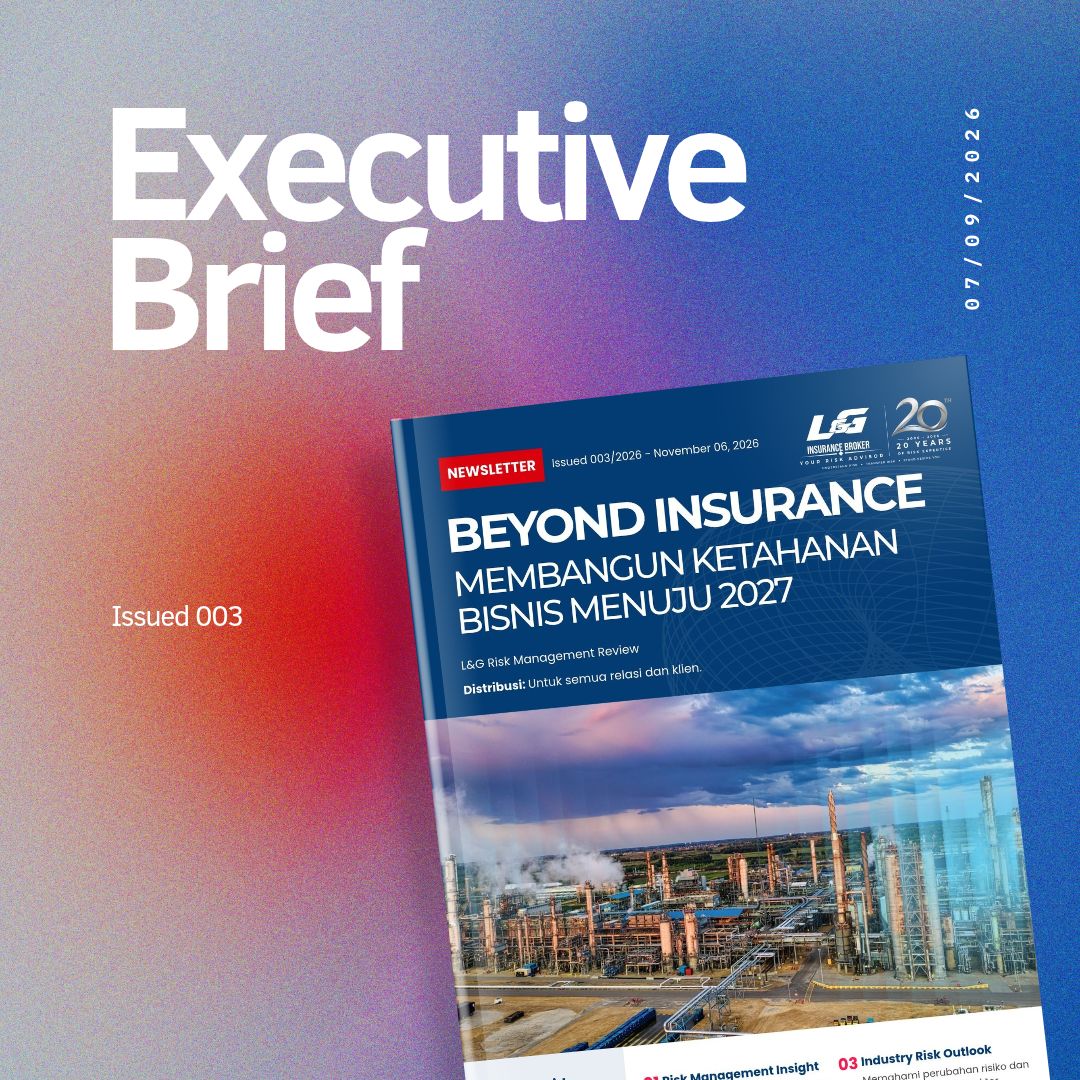
This article introduces some of the critical issues businesses should consider when preparing for 2027. For a broader perspective, explore the latest edition of L&G Risk Management Review – Issue 003/2026: Beyond Insurance – Building Business Resilience for 2027.
Inside this edition, you will discover:
- Risk Management Insights: Hidden risks in business planning and seven essential year-end risk checks.
- Real Claim Experience: How professional broker involvement helped achieve a Marine Cargo claim settlement of approximately Rp17 billion.
- Industry Risk Outlook: Emerging risk developments across mining, power and renewable energy, construction and EPC, manufacturing, shipping and logistics, and oil and gas.
- Insurance Knowledge: Understanding underinsurance and its potential financial consequences.
- Business Resilience Checklist: Practical questions to help management assess business readiness for 2027.