Direktur Utama
Logistics is more than transportation.
A single shipment may travel through multiple modes before reaching its final destination: from factory to truck, from port to vessel, from another port to truck, and finally to a project site or customer.
At every stage, the nature of the risk changes.
Cargo can be damaged during loading. A truck can overturn. A vessel can encounter heavy weather. A warehouse fire can affect multiple customers simultaneously. A road can become inaccessible. A digital system can be disrupted. And even when cargo remains physically intact, a disruption can still prevent it from reaching its destination on time.
As Indonesia’s industrial activity, infrastructure development and international trade continue to generate more complex logistics flows, risk management needs to look beyond individual transportation legs.
The real exposure lies in the entire logistics chain.

Indonesia is fundamentally a logistics-driven economy.
Raw materials move from mines and factories to processing facilities. Finished products move from manufacturers to distribution centres. Heavy equipment travels to mining and construction sites, while project cargo must reach power plants, smelters and infrastructure projects.
The development of ports, industrial estates, connectivity and multimodal transportation is creating greater opportunities for logistics operators.
Recent developments at Patimban Port, for example, illustrate how Indonesia's logistics network is becoming increasingly connected to international shipping routes. Greater connectivity can improve efficiency and create new cargo flows, but it can also increase the concentration of assets and dependencies within the logistics network.
This creates a fundamental risk-management question:
How can greater efficiency be achieved without creating greater vulnerability?
For logistics companies, the answer requires looking beyond the transportation activity itself.
A logistics company may operate as a freight forwarder, transport provider, project cargo specialist, warehouse operator, stevedore, shipping agent or provider of door-to-door services.
Each activity creates a different risk environment.
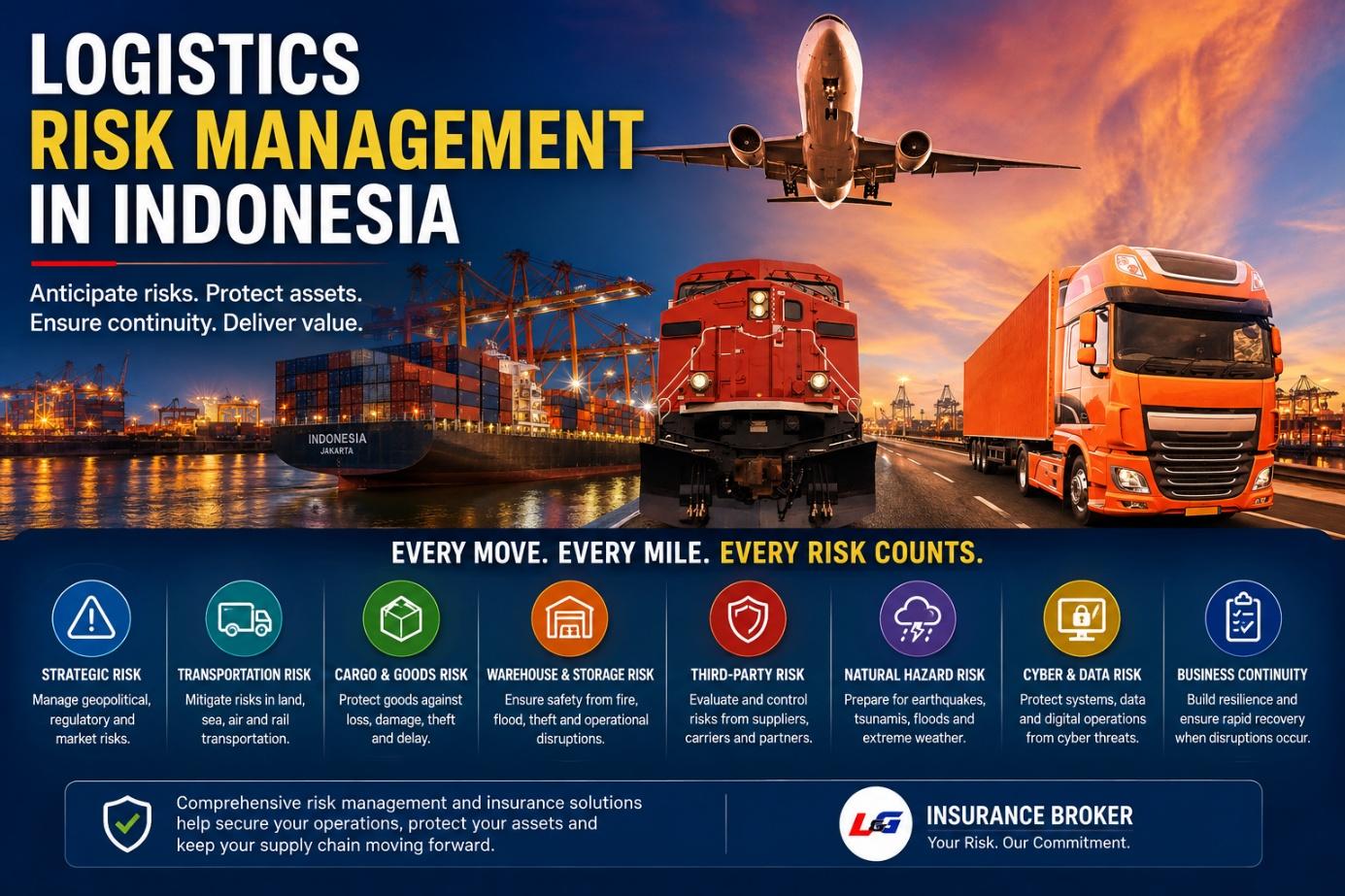
A truck faces accident, overturning, fire, theft and weather-related risks. A vessel faces marine perils. A warehouse faces fire, flood, theft and accumulation risk. Project cargo introduces additional exposures involving route surveys, lifting, loading, unloading, securing and specialised handling.
When several of these activities are combined within one business, the risks are no longer independent.
They become interconnected.
This is particularly important in multimodal logistics.
A typical shipment may follow:
Factory → Truck → Port → Vessel → Port → Truck → Project Site
Every transition represents another potential loss point.
The cargo may pass safely through one stage but encounter a significant exposure at the next.
This means that logistics risk management cannot be limited to individual transportation legs. It needs to consider how risks accumulate and interact throughout the entire journey.
The objective is therefore not simply to move cargo faster.
It is to move cargo safely, predictably and continuously.
The most visible logistics exposure is physical cargo damage.
Depending on the cargo and transportation method, losses may arise from collision, overturning, fire, theft, water damage, improper handling, dropping during loading or unloading, contamination, weather exposure or packaging failure.
The severity of the loss, however, depends heavily on what is being transported.
A damaged shipment of ordinary commercial goods may be replaceable.
A damaged transformer, turbine, generator or major piece of heavy equipment may involve a much larger financial consequence and potentially months of delay.
This makes cargo characteristics an important part of risk assessment.
Heavy and project cargo introduces exposures that can begin before transportation even starts.
A large transformer or industrial machine may require route surveys, assessment of bridge capacity, road conditions, gradients, turning radius and access restrictions.
Loading and unloading procedures also need to be properly engineered. Lifting equipment, securing arrangements and transportation methods must be appropriate to the cargo.
For this type of movement, transportation is therefore not simply a logistics activity.
It is a risk-engineering exercise.
Indonesia's geography makes maritime transportation fundamental to logistics.
Cargo may move through container vessels, bulk carriers, barges, LCTs, tug and barge combinations, Ro-Ro vessels or general cargo vessels.
Each has different risk characteristics.
Heavy weather, collision, grounding, fire, water ingress, cargo shifting and loading or unloading accidents can result in significant losses.
The risk assessment therefore needs to consider not only the cargo, but also the voyage, route, vessel, packing and contractual arrangements.
One of the most underestimated exposures may occur at the final stage of transportation.
Consider a 200-ton transformer travelling to a remote power project.
The vessel may arrive safely. The cargo may be successfully discharged. But the final road may contain narrow bridges, steep gradients, poor surfaces and sharp turns.
The final 100 kilometres may therefore represent one of the highest-risk sections of the entire journey.
This is why risk assessment should follow the actual route, rather than simply assessing the origin and destination.
The value of cargo is only one dimension of logistics exposure.
A logistics company can face multiple layers of loss arising from a single incident.
Warehousing illustrates this clearly.
A single shipment may have a relatively modest value. But a warehouse can contain hundreds or thousands of shipments simultaneously.
A single fire, flood or major incident can therefore affect multiple customers and create a substantial financial exposure.
Risk assessment should consider:
The important question is therefore not simply:
"What is the value of each shipment?"
It is:
"What is the maximum value exposed at this location at one time?"
A logistics company may not own the cargo, but it may still have significant contractual responsibilities toward its customers.
Freight forwarders, warehouse operators, transport companies, stevedores and other logistics providers may each assume different responsibilities.
When a loss occurs, several questions become critical:
This is why logistics risk management needs to be considered together with contractual risk management.
Physical damage may not be the largest financial consequence.
If a warehouse suffers a major fire, for example, repairing the building may solve only one part of the problem.
Customers still need their goods.
Alternative storage may be required. Temporary operations may need to be established. Additional transportation costs may arise. Revenue may decline, while customer relationships may also be affected.
The physical loss can therefore become the starting point of a much larger business interruption.
The exposure can extend even further.
Geopolitical tensions, trade restrictions, extreme weather, port disruptions and infrastructure failures can interrupt supply chains even when cargo itself has not been physically damaged.
A port closure can stop a shipment.
A landslide can make a transportation route inaccessible.
A critical supplier may be unable to deliver.
A customer may be unable to receive cargo.
This creates an important distinction:
Cargo can be physically safe but operationally stranded.
The modern logistics operation also depends increasingly on technology.
GPS tracking, fleet management, IoT sensors, electronic documentation, warehouse management systems and real-time monitoring can significantly improve visibility and operational control.
But dependency on these systems creates another layer of exposure.
A disruption to a transportation management system, warehouse system, customer database, electronic documentation platform or payment system can affect operations even when the physical infrastructure remains intact.
The logistics company therefore needs to manage both physical risk and digital risk.
At L&G, we see logistics risk as a connected system rather than a collection of individual insurance requirements.
The starting point is not:
"What insurance policy should we buy?"
The more fundamental question is:
"What is the maximum financial loss we could suffer, where can it occur, and which part of that risk should be controlled, retained or transferred?"
This requires understanding the logistics operation as a whole.
The assessment should consider the movement of cargo, transportation modes, warehouses, accumulation points, project cargo requirements, contractual responsibilities, liability exposures, business interruption and supply-chain dependencies.
Insurance then becomes one component within that broader risk-management framework.
Depending on the business model and risk profile, a logistics company may require a combination of:
The appropriate programme will depend on the company's actual operations, contractual responsibilities, asset values and risk profile.
But insurance should not be viewed in isolation.
For example, cargo risk may require both appropriate insurance protection and proper packing, handling and securing procedures.
Project cargo may require both insurance and route engineering.
Warehouse exposure may require both stock protection and accumulation controls.
Business interruption may require both financial protection and operational continuity planning.
Supply-chain resilience may require both risk transfer and alternative routes, suppliers or operational arrangements.
This is where logistics risk management becomes broader than insurance.
The objective is not simply to protect the value of cargo after a loss.
It is to reduce the probability and severity of disruption before the loss occurs, while ensuring that the remaining financial exposure can be appropriately managed.
Indonesia's logistics ecosystem will continue to evolve.
Ports are expanding. Industrial estates are generating new cargo flows. Multimodal transportation is developing. Digitalisation is increasing operational visibility. International shipping networks are becoming more connected.
These developments create significant opportunities, but they also create increasingly sophisticated dependencies.
For logistics companies, the question therefore needs to evolve from:
"How do we move the cargo?"
to:
"How do we keep the cargo moving when something goes wrong?"
That is the essence of Logistics Risk Management.
At L&G Insurance Broker, we believe the starting point is understanding the entire chain—from cargo, transportation and warehousing to liability, business interruption, contractual responsibilities and supply-chain resilience.
Because in logistics, cargo does not simply move from Point A to Point B.
It moves through a network of risks.
And the ultimate objective of risk management is simple:
Team
Direktur Utama
Direktur
Terhubung dengan kami
Hubungi Omar untuk mendiskusikan kebutuhan asuransi dan solusi pengelolaan risiko Anda melalui halo@lngrisk.co.id atau WhatsApp.